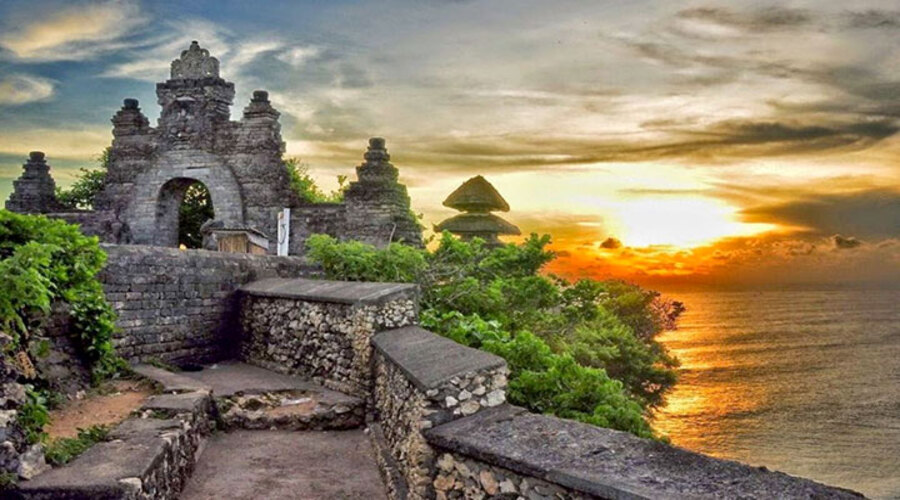
Pura Luhur Uluwatu is spiritually important to the people of the Indonesian island of Bali, as it is one of Bali’s sacred directional temples (kayangan jagat) protecting the island from evil spirits in the southwest.
It’s this proximity to evil, presumably, that compels the temple’s guardians to require the wearing of special sashes or sarongs, as they are supposed to protect visitors from evil influences.
(If you don’t bring your own, don’t worry – these items can be borrowed at the temple gate.)
Beyond this sacred significance, Uluwatu is also the site of one of Bali’s most significant cultural performances: the kecak chant and dance that adapts the famous Ramayana Hindu epic, and plays out against a gorgeous Balinese sunset.
Entering Pura Luhur Uluwatu
You’ll arrive before the kecak dance begins – the tourist tide begins to swell at about 4pm, as the tourist buses bring in kecak viewers from Bali’s many hotels.
You’ll also be asked to wear a sarong if your clothes are too short; you’ll be asked to wear a sash around your waist in any case.
The pathway leading past Pura Luhur Uluwatu and down to the kecak amphitheater is rimmed with trees and infested with kleptomaniac monkeys who like stealing anything glittery. A sign at the entrance warns visitors to stow away their jewelry, eyeglasses, and other valuables to make sure the monkeys don’t get to them first.
The Pura Luhur Uluwatu Temple was built by the Javanese Hindu guru Empu Kuturan in the 10th century. Seven hundred years later, the guru Niratha added further to the temples on the site.
“Ulu” means head, and “Watu” means rock; the temple at “the head of the rock” stands atop a sheer cliff rising two hundred feet above the Indian Ocean.
The temple commands a wonderful view of the sea breaking against the base of the cliffs below, and a totally unforgettable sunset.
Kecak and fire dance is the most compelling part of the temple complex, however, comes from its nightly kecak and fire dance performances.
“Kecak” is derived from an old Balinese ritual called the sanghyang – a trance dance driven by its participants’ repetitive chanting. In its ancient form, the sanghyang communicated the wishes of the gods or of the ancestors.
In the 1930s, a German visitor reformatted the sanghyang into the more familiar kecak performance – doing away with the spiritualistic aspect of the dance and building it around the Hindu Ramayana epic.
No musical instruments are used in a kecak performance – instead, you find about thirty bare-chested men sitting in a circle, uttering “chak… chak… chak” rhythmically and repetitively. The total effect is trance-inducing – repetitive voices and outlandish costumes creating a trippy multimedia experience.
The performance plays out as the sun sets, and the culmination involves a giant fire display that is integral to the plot.
The kecak performance at Pura Luhur Uluwatu takes place on a circular stage, surrounded by bleachers that rise to a maximum of ten feet above ground to give everyone a good view.
To help Uluwatu kecak spectators who are unfamiliar with the Ramayana, synopsis sheets are handed out to audience members before the show. The plot goes like this:
Rama and Sita; Rama, a wise prince and the legal heir of the throne of Ayodha, is exiled from the his father Dasarata’s realm.
He is accompanied by his beautiful wife Sita and his loyal younger brother Laksamana.
While crossing the enchanted forest of Dandaka, the demon king Rahwana spots Sita and lusts after her. Rahwana’s deputy Marica transforms himself into a golden deer to distract Rama and Laksamana.
Rahwana then transforms into an old man to fool Sita into stepping away from a magic circle of protection set by Laksamana – thus fooled, Sita is spirited away to Rahwana’s realm of Alengka.
Rama and Laksamana discover the deception too late; lost in the forest, they encounter the monkey king Hanoman, who swears his allegiance and goes off in search of Sita.
Festival of the Burning Hanoman; Hanoman finds Sita in Alengka. The monkey king takes Rama’s ring to Sita as a token of his contact with her husband. Sita gives Hanoman her hairpin to give to Rama, along with a message that she is waiting for his rescue.
Hanoman marvels at the beauty of Alengka, but begins to destroy it.
Rahwana’s giant servants capture Hanoman, and bind him to be burned. Hanoman uses his magical powers to escape from certain death. Here, the performance ends.
Despite the historical and cultural implications of the performance, the Uluwatu kecak performance is strictly for the tourists. The fiery escape of Hanoman is played up for visual effect, and the actors who play Hanoman, Rahwana, and the giants ham it up mightily.
The first night I watched, Hanoman went up to a bald German tourist in the front row and rubbed the man’s head, to everyone’s amusement. The second time I watched years later, Rahwana’s stooges were permitted to break the fourth wall and make comical speeches in broken English to the audience.
Uluwatu is at Bali’s southwest end, eleven miles south of Kuta. Your taxi or rented ride will take the Bypass from Kuta, heading to Nusa Dua down the road Jalan Uluwatu.
The Uluwatu Kecak Dance is a traditional Balinese performance full of drama and fire. Men perform this dance to ward off evil spirits.
The dance is held in an open-air theater on the island's edge, overlooking the sea.
If you're interested in watching the Kecak Dance, you can also check out tickets for the show in Melasti.
Suitable for: Cultural Traveler, Family Vacationer, and Group Traveler.
Includes/Excludes
Kecak dance ticket
Personal expenses
Tipping
Entrance ticket
Cancellation policy
You can cancel up to 24 hours in advance of the experience for a full refund.
Itinerary
Pick up from hotel
Hotel in Kuta, Nusa Dua, Jimbaran, Ubud, Seminyak, Canggu, Sanur and Denpasar.
Uluwatu Temple
Visit Uluwatu Temple for watching Uluwatu Kecak and Fire Dance Show with sunset.
Drop to hotel
Hotel in Kuta, Nusa Dua, Jimbaran, Ubud, Seminyak, Canggu, Sanur and Denpasar.
Tour maps
Frequently asked questions
What to bring
- Hat.
- Sunglasses.
- Sunscreen.
- Small money for personal expenses.
Know before you go
- There are so many restaurants or warungs around there for eat & drink.
- Pay entrance ticket at ticket counter.
- Show at 6 pm (session 1) and 7 pm (session 2).
How to redeem ticket
- Show mobile or printed ticket at Reservation Only/Agent/Online ticket counter.
Cancellation and reschedule
- Booking can be cancelled before ticket issued for a full refund.
- Booking can not be cancelled after ticket issued, rechedule can be done based on availability.
- Reschedule valid for 30 days, if there is price increase according to date requested, will be recalculated and charged to customer.
- Payment non refundable after ticket issued.
Extra Services
Hotel transfes
Hotel transfers with areas covered Kuta, Seminyak, Canggu, Nusa Dua, Jimbaran, Sanur, Denpasar, and Ubud. Included private car, fuel, and driver. Duration 10 hours.
Rp600,000/person
Sunset Dinner Jimbaran
Enjoy a traditional seafood dinner Jimbaran with authentic dishes, fresh ingredients, and a true taste of local cuisine. Dinner at Tepi Pantai Resto Jimbaran - Set Menu C.
A licensed California tour guide and sommelier, Olivia combines Bay Area sightseeing with curated Napa and Sonoma wine-tasting itineraries. Every tour uses eco-certified electric vehicles.
fromRp150,000Rp140,000 /person
-7%
Make enquiry
Have a question before booking? Message us to learn more.